E minor
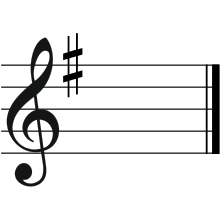
E minor is a minor scale based on E, consisting of the pitches E, F♯, G, A, B, C, and D. Its key signature has one sharp. Its relative major is G major and its parallel major is E major.
 | |
| Relative key | G major |
|---|---|
| Parallel key | E major |
| Dominant key | B minor |
| Subdominant | A minor |
| Component pitches | |
| E, F♯, G, A, B, C, D | |
The E natural minor scale is:
Changes needed for the melodic and harmonic versions of the scale are written in with accidentals as necessary. The E harmonic minor and melodic minor scales are:
Much of the classical guitar repertoire is in E minor, as this is a very natural key for the instrument. In standard tuning (E A D G B E), four of the instrument's six open (unfretted) strings are part of the tonic chord. The key of E minor is also popular in heavy metal music, as its tonic is the lowest note on a standard-tuned guitar.
Notable compositions
- Joseph Haydn
- Wolfgang Amadeus Mozart
- Ludwig van Beethoven
- Niccolò Paganini
- Felix Mendelssohn
- Frédéric Chopin
- Charles-Valentin Alkan
- Le festin d'Ésope, Op. 39, No. 12, from 12 etudes in all the minor keys
- Johannes Brahms
- Pyotr Ilyich Tchaikovsky
- Antonín Dvořák
- Sergei Bortkiewicz
- Étude No. 10, Op. 15
- Nikolai Kapustin
- Étude de concert, Op. 40, No. 3 "Toccatina"
- Edvard Grieg
- Nikolai Rimsky-Korsakov
- Edward Elgar
- Jean Sibelius
- Symphony No. 1, Op. 39
- Ralph Vaughan Williams
- Sergei Rachmaninoff
- Moments musicaux, Op. 16, No. 4
- Symphony No. 2
- Vocalise, Op. 34, No. 14
- Maurice Ravel
- Le tombeau de Couperin
- Sergei Prokofiev
- Montagues and Capulets
- Capriccio No. 5, Op. 12
- Dmitri Shostakovich
- Johann Sebastian Bach
- Bourrée in E minor, BWV 996
- Prelude and Fugue in E minor, BWV 548
- 5th English Suite in E minor, BWV 810
- Felix Blumenfeld
- Prelude Op. 17, No. 4
- Ferrucio Busoni
- Prelude Op. 37, No. 4
- Stephen Heller
- Etude Op. 46, No. 7
- Anton Arensky
- Morceaux caractéristique Op. 36, No. 10 "Ne m'oubliez pas"
- Etude Op. 74, No. 9
gollark: You can, amazingly, talk about ND experiments and not that. Citation: cool flowchart in <#331291747059630082>.
gollark: Yes, exactly.
gollark: Half the important mechanics of DC do that.
gollark: Banning things because it could encourage multiscrolling is *insanely stupid*.
gollark: The reason they're rare is *probably* the stupid forum ban on NDiscussion.
See also
- Key (music)
- Major and minor
- Chord (music)
- Chord names and symbols (popular music)

This article is issued from Wikipedia. The text is licensed under Creative Commons - Attribution - Sharealike. Additional terms may apply for the media files.