Augmented seventh
In classical music from Western culture, an augmented seventh is an interval produced by widening a major seventh by a chromatic semitone. For instance, the interval from C to B is a major seventh, eleven semitones wide, and both the intervals from C♭ to B, and from C to B♯ are augmented sevenths, spanning twelve semitones. Being augmented, it is classified as a dissonant interval.[4] However, it is enharmonically equivalent to the perfect octave.
| Inverse | diminished second |
|---|---|
| Name | |
| Other names | - |
| Abbreviation | A7[1] |
| Size | |
| Semitones | 12 |
| Interval class | 0 |
| Just interval | 125:64[2][3] or 2025:1024[3] |
| Cents | |
| Equal temperament | 1200[3] |
| 24 equal temperament | 1150 |
| Just intonation | 1159[3] or 1180[3] |
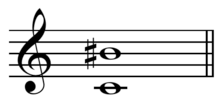

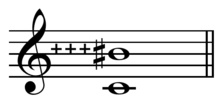
Since an octave can be described as a major seventh augmented by a diatonic semitone, the augmented seventh is the sum of an octave, plus the difference between the chromatic and diatonic semitones, which makes it a highly variable quantity between one meantone tuning and the next. In standard equal temperament, in fact, it is identical to the perfect octave (
In just intonation, three major thirds in succession make up an augmented seventh, which is just short of an octave by 41.05 cents. Adding a diesis to this makes up an octave. Hence, this interval's complement, the diminished second, is often referred to as a diesis.
See also
Sources
- Benward & Saker (2003). Music: In Theory and Practice, Vol. I, p.54. ISBN 978-0-07-294262-0. Specific example of an A7 not given but general example of major intervals described.
- Haluska, Jan (2003). The Mathematical Theory of Tone Systems, p.xxvi. ISBN 0-8247-4714-3. Classic augmented seventh.
- Duffin, Ross W. (2008). How equal temperament ruined harmony : (and why you should care) (First published as a Norton paperback. ed.). New York: W. W. Norton. p. 163. ISBN 978-0-393-33420-3. Retrieved 28 June 2017.
- Benward & Saker (2003), p.92.
| Twelve- semitone (post-Bach Western) |
| ||||||||||||||
|---|---|---|---|---|---|---|---|---|---|---|---|---|---|---|---|
| Other tuning systems |
| ||||||||||||||
| Other intervals |
| ||||||||||||||
