Mixed complementarity problem
Mixed Complementarity Problem (MCP) is a problem formulation in mathematical programming. Many well-known problem types are special cases of, or may be reduced to MCP. It is a generalization of nonlinear complementarity problem (NCP).
Definition
The mixed complementarity problem is defined by a mapping , lower values and upper values .


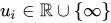
The solution of the MCP is a vector such that for each index one of the following alternatives holds:

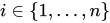
- ;
- ;
- .



Another definition for MCP is: it is a variational inequality on the parallelepiped .

See also
References
- Stephen C. Billups (1995). "Algorithms for complementarity problems and generalized equations" (PS). Retrieved 2006-08-14. Cite journal requires
|journal=(help) - Francisco Facchinei, Jong-Shi Pang (2003). Finite-Dimensional Variational Inequalities and Complementarity Problems, Volume I.
This article is issued from Wikipedia. The text is licensed under Creative Commons - Attribution - Sharealike. Additional terms may apply for the media files.