Introduction to Arithmetic
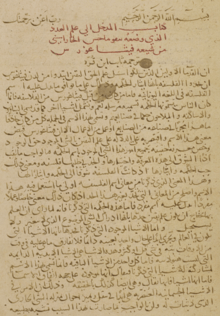
The book Introduction to Arithmetic (Greek: Ἀριθμητικὴ εἰσαγωγή, Arithmetike eisagoge) is the only extant work on mathematics by Nicomachus (60–120 AD).
Summary
The work contains both philosophical prose and basic mathematical ideas. Nicomachus refers to Plato quite often, and writes that philosophy can only be possible if one knows enough about mathematics. Nicomachus also describes how natural numbers and basic mathematical ideas are eternal and unchanging, and in an abstract realm. It consists of two books, twenty-three and twenty-nine chapters, respectively.
Although he was preceded by the Babylonians and the Chinese,[1] Nicomachus provided one of the earliest Greco-Roman multiplication tables, whereas the oldest extant Greek multiplication table is found on a wax tablet dated to the 1st century AD (now found in the British Museum).[2]
Editions
- Nicomachus of Gerasa Introduction to arithmetic, translated into English by Martin Luther D'Ooge; with studies in Greek arithmetic by Frank Egleston Robbins and Louis Charles Karpinski, University of Michigan studies (London: Macmillan, 1926).
- Nicomachus of Gerasa Introduction to arithmetic, translated into English by Martin Luther D'Ooge; with studies in Greek arithmetic by Frank Egleston Robbins and Louis Charles Karpinski (London: Johnson Reprint Corp., 1972).
See also
References
- Jane Qiu (January 7, 2014). "Ancient times table hidden in Chinese bamboo strips". Nature News. doi:10.1038/nature.2014.14482.
- David E. Smith (1958), History of Mathematics, Volume I: General Survey of the History of Elementary Mathematics, New York: Dover Publications (a reprint of the 1951 publication), ISBN 0-486-20429-4, pp 58, 129.
External links
 |
Wikiquote has quotations related to: Introduction to Arithmetic |
- Nicomachus' "Introduction to Arithmetic", translated by Martin Luther D'Ooge at archive.org.
- Nicomachus of Gerasa: Introduction to Arithmetic (1926) translated in English by Martin Luther D'Ooge with studies in Greek arithmetic by Frank Egleston Robbins and Louis Charles Karpinski at Haithi Trust Digital Library