Hustler
Hustler is a period-3 oscillator that was found by Robert Wainwright in June 1971.[1][2]
| Hustler | |||||||||||
| |||||||||||
| View animated image | |||||||||||
| View static image | |||||||||||
| Pattern type | Oscillator | ||||||||||
|---|---|---|---|---|---|---|---|---|---|---|---|
| Oscillator type | Billiard table | ||||||||||
| Number of cells | 30 | ||||||||||
| Bounding box | 11×12 | ||||||||||
| Period | 3 | ||||||||||
| Mod | 3 | ||||||||||
| Heat | 4 | ||||||||||
| Volatility | 0.17 | ||||||||||
| Strict volatility | 0.17 | ||||||||||
| Discovered by | Robert Wainwright | ||||||||||
| Year of discovery | 1971 | ||||||||||
| |||||||||||
| |||||||||||
| |||||||||||
| |||||||||||
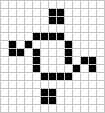


Image gallery
 The original form of the hustler |
gollark: (this isn't about a single actual physical molecule or something changing, but the genes for it changing slightly over time and producing different verisons)
gollark: I guess so. If you need, say, ten changes to an enzyme to bring it from one state to a much better one, but it works much worse/totally breaks while it's in the middle of both, it's hard for it to evolve to the better version.
gollark: If one what is stuck?
gollark: I was going to say, though: with human eyes - the light-sensitive bit is behind some other stuff, and while a goal-directed human engineer would probably go "I'll just rotate this thing then", if you don't have a convenient series of changes which still leave everything working in each intermediate state, you can't really get it evolving into the new version.
gollark: I... don't really know a massive amount about this, to be honest.
See also
References
- Robert Wainwright (June 1971). "Lifeline Volume 2".
- Dean Hickerson's oscillator stamp collection. Retrieved on March 14, 2020.
This article is issued from Conwaylife. The text is licensed under Creative Commons - Attribution - Sharealike. Additional terms may apply for the media files.