Four color theorem

13

0

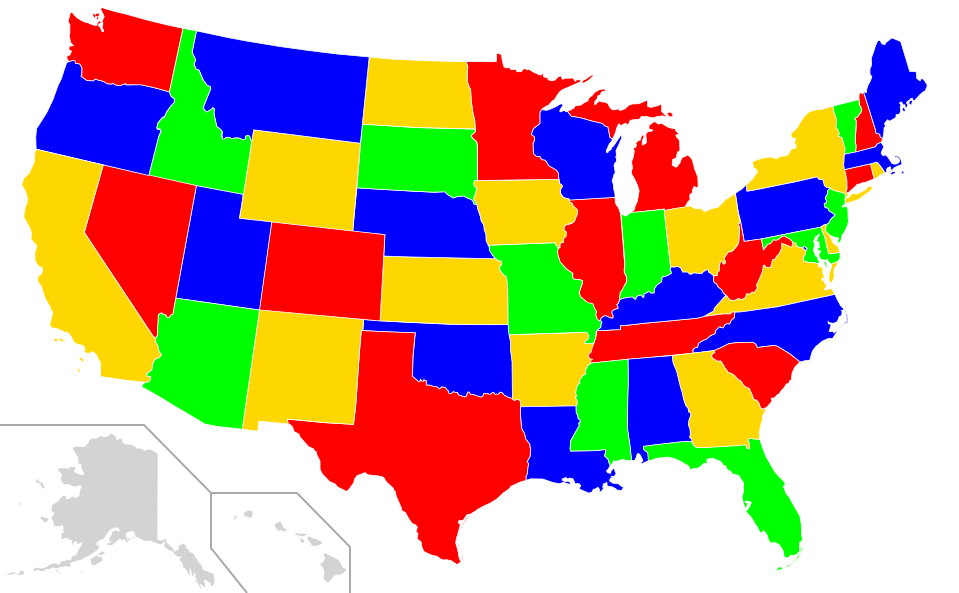
The Four color theorem States that no more than four colors are required to color the regions of a map.

The challenge

Given a list of State borders assign each state ID a color so that no two adjacent states have the same color. The output Should be a CSS stylesheet assigning the color to the state's 2 letter ID code. Here is a SVG map which the stylesheet could be applied to. http://upload.wikimedia.org/wikipedia/commons/3/32/Blank_US_Map.svg

The rules

  • Shortest code wins
  • any state border list can be used
  • only 4 colors can be used.
  • the state list can be hardcoded

Advice: Use the CSS fill: property to change the color, For example #AL{fill:green}

Here is a list of state borders

AL-FL
AL-GA
AL-MS
AL-TN
AR-LA
AR-MO
AR-MS
AR-OK
AR-TN
AR-TX
AZ-CA
AZ-CO
AZ-NM
AZ-NV
AZ-UT
CA-NV
CA-OR
CO-KS
CO-NE
CO-NM
CO-OK
CO-UT
CO-WY
CT-MA
CT-NY
CT-RI
DC-MD
DC-VA
DE-MD
DE-NJ
DE-PA
FL-GA
GA-NC
GA-SC
GA-TN
IA-MN
IA-MO
IA-NE
IA-SD
IA-WI
ID-MT
ID-NV
ID-OR
ID-UT
ID-WA
ID-WY
IL-IA
IL-IN
IL-KY
IL-MO
IL-WI
IN-KY
IN-MI
IN-OH
KS-MO
KS-NE
KS-OK
KY-MO
KY-OH
KY-TN
KY-VA
KY-WV
LA-MS
LA-TX
MA-NH
MA-NY
MA-RI
MA-VT
MD-PA
MD-VA
MD-WV
ME-NH
MI-OH
MI-WI
MN-ND
MN-SD
MN-WI
MO-NE
MO-OK
MO-TN
MS-TN
MT-ND
MT-SD
MT-WY
NC-SC
NC-TN
NC-VA
ND-SD
NE-SD
NE-WY
NH-VT
NJ-NY
NJ-PA
NM-OK
NM-TX
NM-UT
NV-OR
NV-UT
NY-PA
NY-VT
OH-PA
OH-WV
OK-TX
OR-WA
PA-WV
SD-WY
TN-VA
UT-WY
VA-WV

kyle k

Posted 2014-10-25T22:24:36.427

Reputation: 409

Can we hardcode the list of state borders? – NinjaBearMonkey – 2014-10-25T22:59:44.580

@hsl yes, it is ok to hardcode state borders. – kyle k – 2014-10-26T03:26:25.317

@steveverrill if you can think of a better method of changing colors that would be great. I added an example showing how to use CSS. – kyle k – 2014-10-26T03:37:29.913

Wouldn't this require reproducing the proof the Four Color Theorem itself? Since you have to handle every possible case? – barrycarter – 2014-10-26T05:19:27.777

1Wouldn't this Theorem prove wrong if a state's border is touching more than 3 other states ? – Optimizer – 2014-10-26T06:11:24.913

My mathematical pedantry forces me to point out that your explanation of the 4 colour theorem isn't right, one colour is enough if you don't put constrains on the colouring! – None – 2014-10-26T06:51:32.177

Oh wow, I was just thinking of this as a challenge! – Beta Decay – 2014-10-26T07:43:22.723

Ok the CSS is clear, you have my upvote now. I deleted my previous comment about hardcoding as it wasnt your intention. I guess you mean that if it's read in the state data doesn't count in your byte count but if it's hardcoded it does? Allowing hardcoding data on problems like this is a slippery slope towards hardcoding solutions. Anyway, the existing answer uses 60 bytes to parse the data, while hardcoded data would need 6 bits for each of the 109 borders just to hold a numeric value for one state (without even considering the other state or the letter codes) so I don't think its worth it. – Level River St – 2014-10-26T09:06:56.313

@Optimizer TN borders 7 other states and yet the US can still be 4-colored. Just because two states border TN doesn't mean they border each other. – barrycarter – 2014-10-26T17:21:46.183

Answers

4

Python, 320 chars

import sys,random
S=[]
E={}
for x in sys.stdin:a=x[:2];b=x[3:5];S+=[a,b];E[a,b]=E[b,a]=1
C={0:0}
while any(1>C[s]for s in C):
 C={s:0for s in S};random.shuffle(S)
 for s in S:
    A=set([1,2,3,4])-set(C[y]for x,y in E if x==s)
    if A:C[s]=random.choice(list(A))
for s in C:print'#%s{fill:%s}'%(s,' bglrloieulmdede'[C[s]::4])

Uses a randomized algorithm. Assign colors to states in random order by selecting a color that doesn't conflict with adjacent states that have already been colored. Seems to work in a tenth of a second or so on the given input.

Example output:

$ 4color.py < stategraph
#WA{fill:red}
#DE{fill:gold}
#DC{fill:blue}
#WI{fill:blue}
#WV{fill:red}
#FL{fill:lime}
#WY{fill:gold}
#NH{fill:red}
#NJ{fill:lime}
#NM{fill:gold}
#TX{fill:red}
#LA{fill:blue}
#NC{fill:blue}
#ND{fill:gold}
#NE{fill:blue}
#TN{fill:red}
#NY{fill:gold}
#PA{fill:blue}
#RI{fill:gold}
#NV{fill:red}
#VA{fill:gold}
#CO{fill:red}
#CA{fill:gold}
#AL{fill:blue}
#AR{fill:gold}
#VT{fill:lime}
#IL{fill:red}
#GA{fill:gold}
#IN{fill:lime}
#IA{fill:gold}
#OK{fill:blue}
#AZ{fill:lime}
#ID{fill:lime}
#CT{fill:red}
#ME{fill:blue}
#MD{fill:lime}
#MA{fill:blue}
#OH{fill:gold}
#UT{fill:blue}
#MO{fill:lime}
#MN{fill:red}
#MI{fill:red}
#KS{fill:gold}
#MT{fill:blue}
#MS{fill:lime}
#SC{fill:red}
#KY{fill:blue}
#OR{fill:blue}
#SD{fill:lime}

Example pasted into svg.

Keith Randall

Posted 2014-10-25T22:24:36.427

Reputation: 19 865

tan is apparently a supported SVG colour. Shame that you can only get one three-colour one with the ::4 trick. – Peter Taylor – 2014-10-26T08:00:40.433

1@PeterTaylor: tan looks awful. Totally worth 1 character to use gold instead. – Keith Randall – 2014-10-26T08:02:23.467

Can you guarantee this algorithm will always finish in finite time provided a 4-color solution exists? :) – barrycarter – 2014-10-26T17:18:11.297

@barrycarter: It is guaranteed to finish with probability 1. It might take time exponential in the size of the map, though. – Keith Randall – 2014-10-26T17:42:04.153

@KeithRandall I was sort of teasing, but... if you check for repeats, it could take 4^(n-1) steps to find the right coloring (n-1 because of symmetry of the colors). If you don't check for repeats, it could take longer still. I just found the solution unsatisfying, since it's not "really" a "proper" algorithm. – barrycarter – 2014-10-26T17:57:05.267

3

Prolog, 309 307 283 chars

:-initialization m.
a-X:-assert(X);retract(X),1=0.
r:-maplist(get_char,[A,B,E,C,D,F]),(E=F;X=[A,B],Y=[C,D],a-X/Y,a-Y/X,(s/X;a-s/X),(s/Y;a-s/Y),r).
s+[]:- \+ (X*C,writef('#%s{fill:#%w}',[X,C]),1=0).
s+[X|T]:-member(C,[911,191,119,991]),a-X*C,\+ (X/Y,Y*C),s+T.
m:-r,bagof(X,s/X,L),s+L.

The algorithm uses backtracking / depth-first search to fill out the map.

A bit more readable:

:- initialization(main).

% Found on http://awarth.blogspot.de/2008/08/asserts-and-retracts-with-automatic.html
assert2(X) :- assert(X).
assert2(X) :- retract(X), fail.

% Reads all states into clauses "state-State",
% and all connections into "State-Neighbor" and "Neighbor-State".
read_states :-
    % Read a line "AB-CD\n"
    maplist(get_char, [A,B,E,C,D,F]),
    (   A = F;
        State = [A, B],
        Neighbor = [C, D],
        % Memorize the connection between State and Neighbor in both directions.
        assert(State/Neighbor),
        assert(Neighbor/State),
        % Memorize State and Neighbor for the list of states.
        (state/State; assert(state/State)),
        (state/Neighbor; assert(state/Neighbor)),
        % Continue for all lines.
        read_states
    ).

% Print out all colors.
solve([]) :-
    once((
        State*Color,
        writef('#%s{fill:%w}', [State, Color]),
        fail
    )); !.

% Use depth-first search to color the map.
solve([State|FurtherStates]) :-
    member(Color, ['#911', '#191', '#119', '#991']),
    assert2(State*Color),
    \+ (State/Neighbor, Neighbor*Color),
    solve(FurtherStates).

main :-
    read_states,
    bagof(State, state/State, States),
    solve(States).

Invocation:

cat borders.txt | swipl -q ./fourcolors.pl

Result (newlines are not needed):

#AL{fill:#911}#FL{fill:#191}#GA{fill:#119}#MS{fill:#191}#TN{fill:#991}#AR{fill:#911}#LA{fill:#119}#MO{fill:#191}#OK{fill:#119}#TX{fill:#191}#AZ{fill:#911}#CA{fill:#191}#CO{fill:#191}#NM{fill:#991}#NV{fill:#991}#UT{fill:#119}#OR{fill:#911}#KS{fill:#911}#NE{fill:#119}#WY{fill:#911}#CT{fill:#911}#MA{fill:#191}#NY{fill:#119}#RI{fill:#119}#DC{fill:#911}#MD{fill:#191}#VA{fill:#119}#DE{fill:#119}#NJ{fill:#191}#PA{fill:#911}#NC{fill:#911}#SC{fill:#191}#IA{fill:#911}#MN{fill:#191}#SD{fill:#991}#WI{fill:#119}#ID{fill:#191}#MT{fill:#119}#WA{fill:#119}#IL{fill:#991}#IN{fill:#191}#KY{fill:#911}#MI{fill:#911}#OH{fill:#119}#WV{fill:#991}#NH{fill:#911}#VT{fill:#991}#ME{fill:#191}#ND{fill:#911}

Pasted into an SVG: http://jsbin.com/toniseqaqi/

kay - SE is evil

Posted 2014-10-25T22:24:36.427

Reputation: 230

1

JavaScript (ES6) 269 279

Recursive search with backtracking. ~80 bytes spent for state list parsing.

 F=l=>{
   S=(a,b)=>S[a]=(S[a]||[]).concat(b),
   l.replace(/(..)-(..)/g,(_,a,b)=>S(a,b)+S(b,a)),
   k=Object.keys(S),
   R=(p,c=k[p])=>!c||['blue','gold','red','tan'].some(i=>!c.some(t=>S[t].c==i)&&(c.c=i,R(p+1)||(c.c='')),c=S[c]),
   R(0),
   k.map(k=>console.log('#'+k+'{fill:'+S[k].c+'}'))
 }

Ungolfed

F=l=>{
  var states = {}; // hash table with adiacent list for each state
  S=(a,b)=>states[a]=(states[a]||[]).concat(b);
  l.replace(/(..)-(..)/g,(_,a,b)=>S(a,b)+S(b,a)); // build the hash table from the param list 

  keys = Object.keys(states); // get the list of hashtable keys as an array (the 49 states id)
  Scan=(p)=> // Recursive scan function
  {
    var sId = keys[p]; // in sid the current state id, or undefined if passed last key
    if (!sId) return true; // end of keys, recursive search is finished 
    var sInfo = states[sId]; // in sInfo the aarray of adiacent states id + the color property

    return ['blue','gold','red','tan'].some( (color) => // check the four avaialabe colors
      {
        var colorInUse = sInfo.some( (t) => states[t].color == color); // true if an adiacent state already has the currnet color
        if (!colorInUse) // if the color is usable
        {
          sInfo.color = color; // assign the current color to the current state
          var ok = Scan(p+1); // proceed with the recursive scan on the next state
          if (!ok) // if recursive scan failed, backtrack
          {
            sInfo.color = ''; // remove the assigned color for the current state
          }
          return ok;
        }
      }
    )
  },
  Scan(0), // start scan 
  keys.forEach( (sId) => console.log('#'+sId+'{fill:'+states[sId].color+'}')) // output color list
}

Test in FireFox/FireBug console

list = "AL-FL AL-GA AL-MS AL-TN AR-LA AR-MO AR-MS AR-OK AR-TN AR-TX AZ-CA AZ-CO AZ-NM "+
"AZ-NV AZ-UT CA-NV CA-OR CO-KS CO-NE CO-NM CO-OK CO-UT CO-WY CT-MA CT-NY CT-RI "+
"DC-MD DC-VA DE-MD DE-NJ DE-PA FL-GA GA-NC GA-SC GA-TN IA-MN IA-MO IA-NE IA-SD "+
"IA-WI ID-MT ID-NV ID-OR ID-UT ID-WA ID-WY IL-IA IL-IN IL-KY IL-MO IL-WI IN-KY "+
"IN-MI IN-OH KS-MO KS-NE KS-OK KY-MO KY-OH KY-TN KY-VA KY-WV LA-MS LA-TX MA-NH "+
"MA-NY MA-RI MA-VT MD-PA MD-VA MD-WV ME-NH MI-OH MI-WI MN-ND MN-SD MN-WI MO-NE "+
"MO-OK MO-TN MS-TN MT-ND MT-SD MT-WY NC-SC NC-TN NC-VA ND-SD NE-SD NE-WY NH-VT "+
"NJ-NY NJ-PA NM-OK NM-TX NM-UT NV-OR NV-UT NY-PA NY-VT OH-PA OH-WV OK-TX OR-WA "+
"PA-WV SD-WY TN-VA UT-WY VA-WV";
F(list);

Output

#AL{fill:blue}
#FL{fill:gold}
#GA{fill:red}
#MS{fill:gold}
#TN{fill:tan}
#AR{fill:blue}
#LA{fill:red}
#MO{fill:gold}
#OK{fill:red}
#TX{fill:gold}
#AZ{fill:blue}
#CA{fill:gold}
#CO{fill:gold}
#NM{fill:tan}
#NV{fill:tan}
#UT{fill:red}
#OR{fill:blue}
#KS{fill:blue}
#NE{fill:red}
#WY{fill:blue}
#CT{fill:blue}
#MA{fill:gold}
#NY{fill:red}
#RI{fill:red}
#DC{fill:blue}
#MD{fill:gold}
#VA{fill:red}
#DE{fill:red}
#NJ{fill:gold}
#PA{fill:blue}
#NC{fill:blue}
#SC{fill:gold}
#IA{fill:blue}
#MN{fill:gold}
#SD{fill:tan}
#WI{fill:red}
#ID{fill:gold}
#MT{fill:red}
#WA{fill:red}
#IL{fill:tan}
#IN{fill:gold}
#KY{fill:blue}
#MI{fill:blue}
#OH{fill:red}
#WV{fill:tan}
#NH{fill:blue}
#VT{fill:tan}
#ME{fill:gold}
#ND{fill:blue}

edc65

Posted 2014-10-25T22:24:36.427

Reputation: 31 086